Peer-reviewed work and other publications.
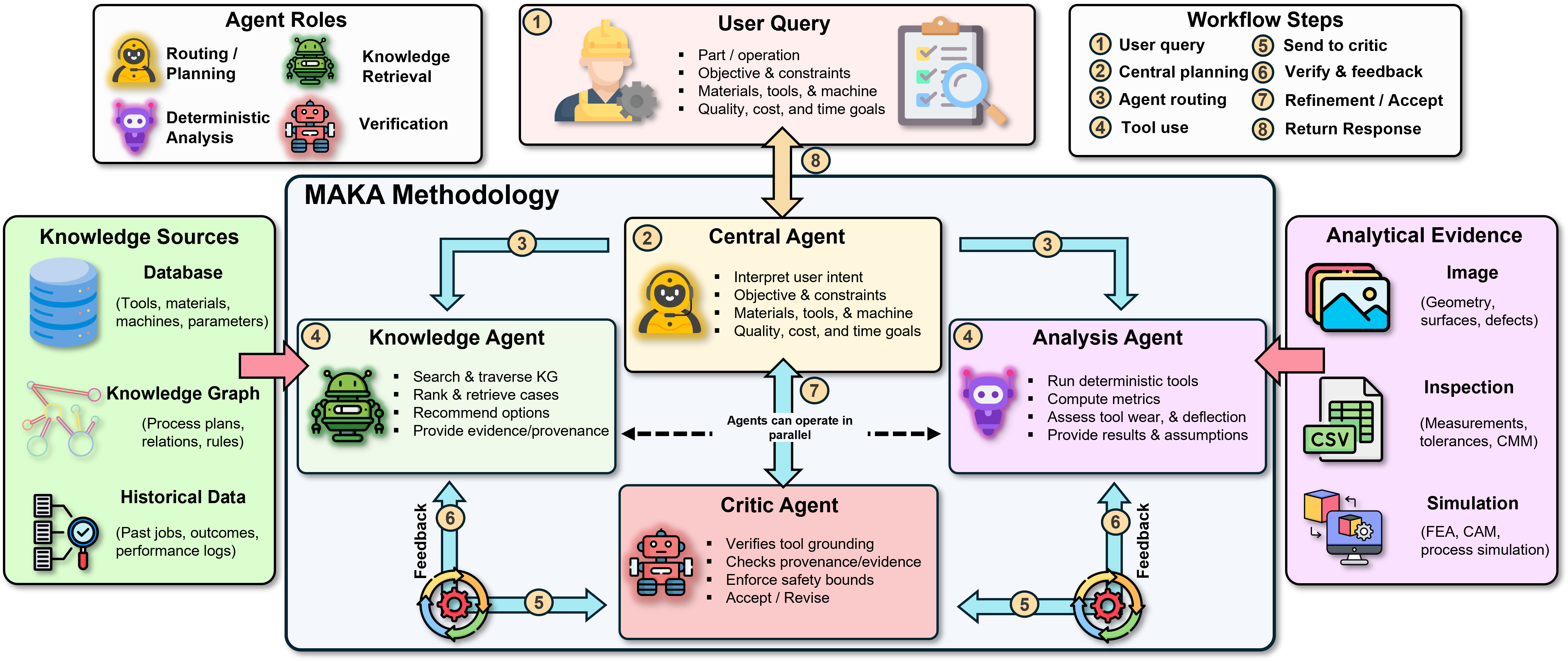
Physics-grounded multi-agent architecture for traceable, risk-aware human–AI decision support in manufacturing
Journal of Manufacturing Systems, 2026
We present multi-agent knowledge analysis (MAKA), a decision-support architecture that separates intent routing, tools-only quantitative analysis, knowledge graph retrieval, and critic-based verification
that enforces physical plausibility, safety bounds, and provenance completeness before recommendations are surfaced for human approval. In a three-level tool-orchestration benchmark spanning single-step to three-or-more-step stateful sequences,
MAKA increased the pass rate for correct tool selection, argument
assignment, and dependency-consistent execution by a mean, median, and maximum of 22.9, 8.0, and 64.0
percentage points, respectively, across 15 model-level comparisons over the stronger of the ReAct-style and
structured function-calling baselines with identical model and tool access.
Read paper (PDF)
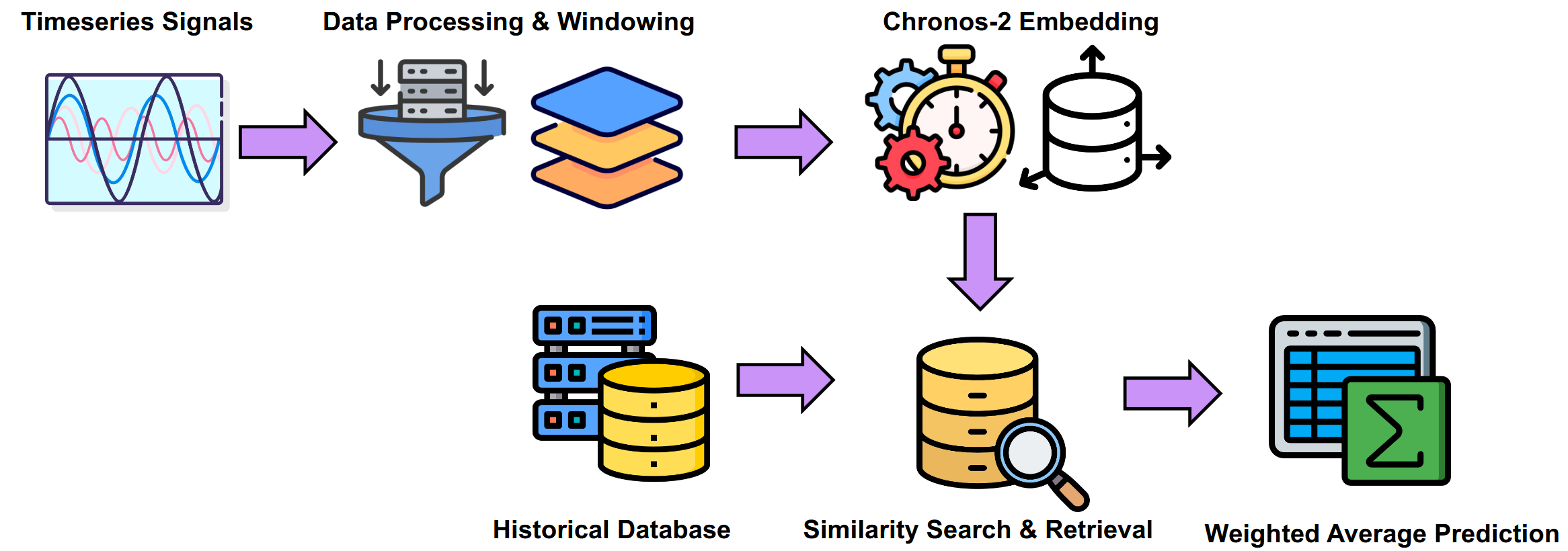
Decision-Centric Virtual Metrology for Geometric Deviation via Foundation-Embedding Retrieval
Ground Vehicle Systems Engineering and Technology Symposium, 2026
This paper introduces ChronosGD, a retrieval-based virtual metrology framework. ChronosGD predicts pointwise geometric
deviation from multichannel time series data by: (1) retrieving the most
similar historical process windows in a frozen Chronos-2 embedding space, and
(2) transferring deviation information through similarity-weighted aggregation.
ChronosGD avoids plant-specific gradient retraining during deployment; adaptation is achieved by refreshing a
labeled historical memory as new inspected parts become available, while preserving traceability through explicit neighbor provenance.
Read paper (PDF)
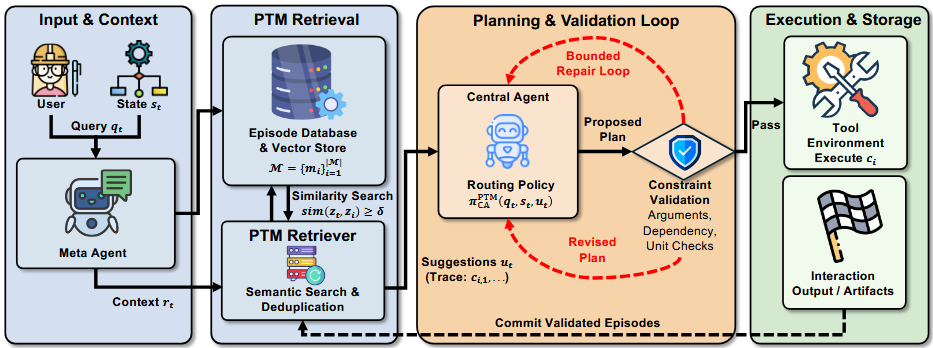
Operationalizing Foundation Agents in Manufacturing via Persistent Workflow Memory
International Symposium on Flexible Automation, 2026
We introduce persistent tool memory (PTM), a validation-gated, retrieval-augmented memory that capturessuccessful tool-use episodes as reusable workflow priors.
PTM significantly improves tool-use recall and first-pass planning accuracy, with the largest gains occurring in deeper workflows where baseline agents systematically derail. Moreover, PTM reduces model-size dependence;
a 7B-parameter model equipped with PTM approaches the performance of 30B+ models by grounding planning decisions in previously validated execution traces.
Read paper (PDF)
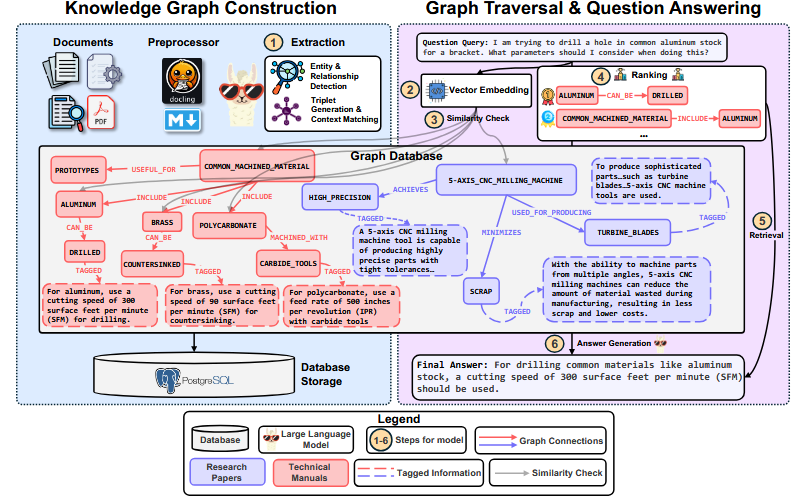
Knowledge Graph Fusion with Large Language Models for Accurate, Explainable Manufacturing Process Planning
International Journal of Production Economics, 2026
Augmented Retrieval Knowledge Network Enhanced Search & Synthesis (ARKNESS) is introduced as an end-to-end
CNC process planning framework, achieving verifiable, numerically exact answers by combining zero-shot
Knowledge Graph construction with retrieval-augmented generation. Furthermore, ARKNESS improves multiple-choice
accuracy by up to +16.6 percentage points, F1-score by +16.5 percentage points, and ROUGE-L by 8.9×, enabling
smaller on-prem models to match or surpass larger cloud models for privacy-preserving, real-time shop-floor inference.
Read paper (PDF)
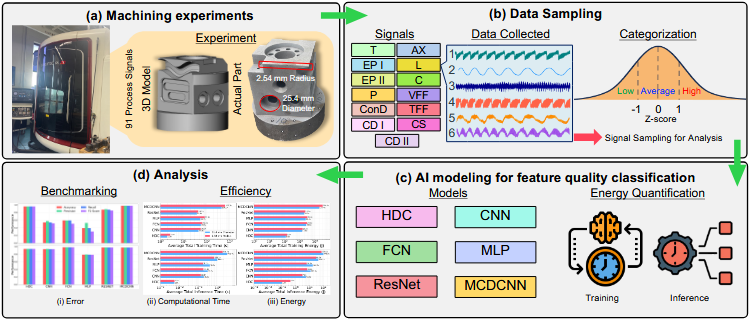
Hyperdimensional Computing for Sustainable Manufacturing: An Initial Assessment
Manufacturing Letters, 2026
HyperDimensional Computing (HDC) is introduced as an alternative, achieving accuracy comparable to conventional models
while drastically reducing energy consumption, 200× for training and 175 to 1000× for inference.
Furthermore, HDC reduces training times by 200× and inference times by 300 to 600×,
showcasing its potential for energy-efficient smart manufacturing.
Read paper (PDF)
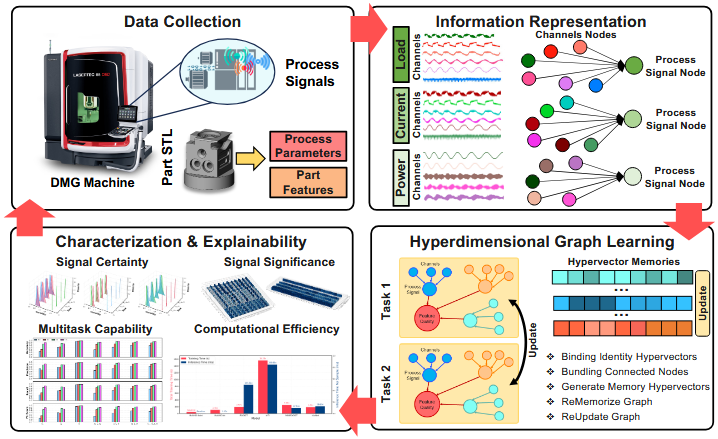
Hyperdimensional Computing for Explainable Information Fusion and Multi-Task Adaptation in Advanced Manufacturing
Information Fusion, 2025
This paper introduces MultiHd, a graph-based hyperdimensional computing framework that intrinsically integrates
explainability, multi-task learning, and computational efficiency to overcome these limitations.
By encoding multi-channel time series data into a structured graph, MultiHD captures interdependencies
among signals using hyperdimensional representations, enabling computationally efficient parallel processing and rapid inference.
Read paper (PDF)
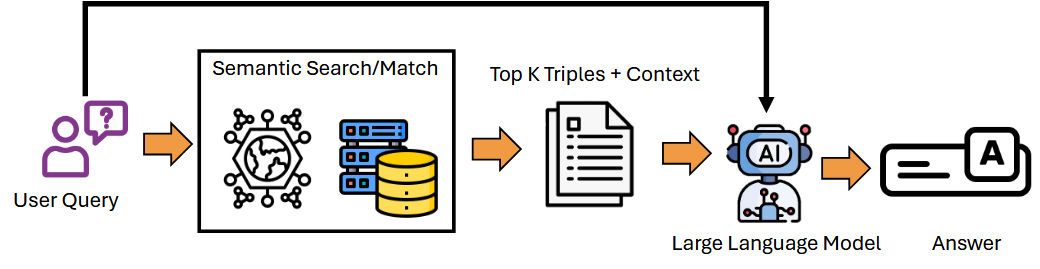
Enabling Grounded Answers through Knowledge Graphs and Retrieval Augmented Generation
Ground Vehicle Systems Engineering and Technology Symposium, 2025
This paper presents GraphLLM, integrating knowledge graphs with LLMs to extract relations,
curb hallucinations, and improve technical answers, achieving 25% gains on LLaMA,
supporting precise decisions in advanced manufacturing.
Read paper (PDF)
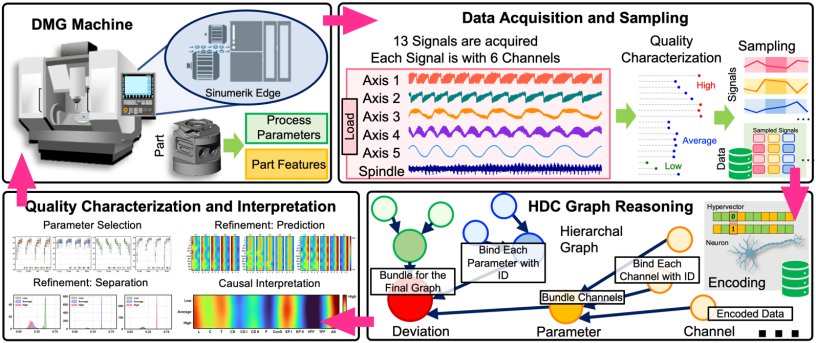
Hierarchical Representation and Interpretable Learning for Accelerated Quality Monitoring in Machining Process
CIRP Journal of Manufacturing Science and Technology, 2024
This research introduces a novel graph-based hyper-dimensional computing
framework that not only assesses work-piece quality on-edge in 5-axis CNC
machining, but also characterizes the key signals vital for evaluating
quality from in-situ multichannel data.
Read paper (PDF)
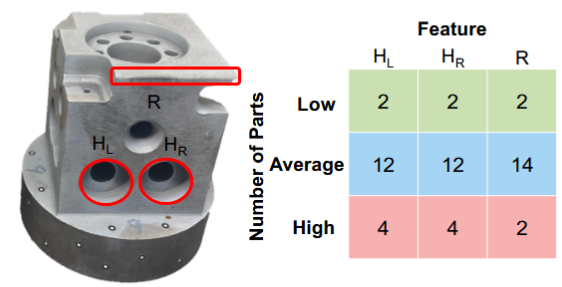
Multi-Task Brain-Inspired Learning for Interlinking Machining Dynamics With Parts Geometrical Deviations
International Manufacturing Science and Engineering Conference, 2024
We introduce MTaskHD, a novel multi-task framework, that leverages
hyperdimensional computing (HDC) to effortlessly fuse data from
various channels and process signals while characterizing quality
within a multi-task manufacturing operation.
Read paper (PDF)
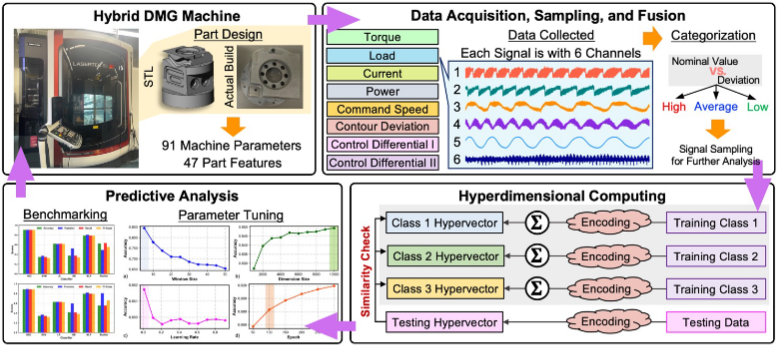
Edge Cognitive Data Fusion: From In-Situ Sensing to Quality Characterization in Hybrid Manufacturing Process
International Manufacturing Science and Engineering Conference, 2023
This paper introduces hyperdimensional computing (HDC) to fuse load, current, torque,
command speed, control differential, power, and contour deviation which provides
robust, sample-efficient, and explainable learning of quality characterization.
Read paper (PDF)
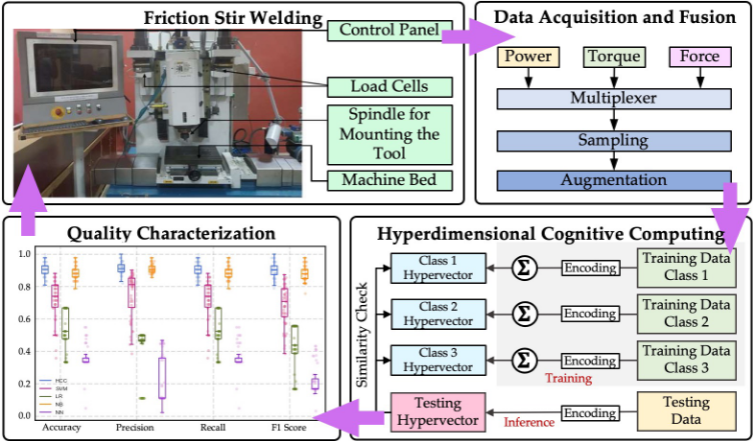
Data Fusion Cognitive Computing for Characterization of Mechanical Property in Friction Stir Welding Process
International Design Engineering Technical Conferences and Computers and Information in Engineering Conference, 2023
This research introduces hyperdimensional cognitive computing (HCC) that
mimics human brain functionalities to fuse power, torque, and force data
to provide robust, sample-efficient, and explainable learning for process-property
characterization in friction stir welding.
Read paper (PDF)